Thursday, August 16, 2007

A break forecast - be back somewhere in September

The site goes on to hibernation due to external pressures and will be resumed in late September. Check the blogroll and Wallstrip and watch the meltdown in process meanwhile.

Type rest of the post here

Read More......

Tuesday, August 07, 2007

Short history of credit boom and bust cycle

Following our last 2 weeks of volatility in the markets and the today's "Inflation Gunslinger" Ben Bernanke's fed funds rate decision, I decided to put a short a video on credit cycles from WSJ (Via Barry Ritholtz)

Unfortunately the link to the video is bad or the embedding does not work as i want it to. Here is the link:

http://link.brightcove.com/services/link/bcpid452319854/bctid1135485949


A short abstract from the article:

" ...
Side Effects of Deflation Fight

When a technology stock and investment plunge and the Sept. 11 terrorist attacks pushed the economy into recession in 2001, the Fed slashed interest rates. But even by mid-2003, job creation and business investment were still anemic, and the inflation rate was slipping toward 1%. The Fed began to study Japan's unhappy bout with deflation -- generally declining prices -- which made it harder to repay debts and left the central bank seemingly powerless to stimulate growth.

"Even though we perceive the risks [of deflation] as minor, the potential consequences are very substantial and could be quite negative," Mr. Greenspan said in May 2003. A month later, the Fed cut the target for its key federal-funds interest rate, a benchmark for all short-term rates, to 1%. It said the rate would stay there as long as necessary, figuring low rates would bolster housing and consumer spending until business investment and exports recovered. The rate stayed at 1% for a year.


Mr. Greenspan raised vague fears with colleagues over the possibility this policy could create distortions in the economy, but he says today that such risks were an acceptable price for insuring against deflation. "Central banks cannot avoid taking risks. Such trade-offs are an integral part of policy. We were always confronted with choices." ..."

Credit structure unwinding and market pricing the risk in such structures (no guarantee that the pricing will be efficient at least during the first period) this credit bust cycle can carry with it some far reaching consequences for the global economy. Mexico being a small open economy tied to US monetary policy by trade will see some interesting volatile times, the range and timing of that volatility however remain difficult to gauge.

Read More......

Friday, August 03, 2007

Land vs. Sea: Lower unit costs change the history

Cost-benefit analysis can explain the supremacy of Britain on the seas? Read this comments from Brad DeLong's blog


Read below:

"... Hoisted from comments: Monte Davis writes:

Grasping Reality with Both Hands: Brad DeLong's Semi-Daily Journal: John Keegan notes somewhere that in the War of Independence, when the colonists desperately needed the captured cannon from Ticonderoga and Crown Point, it took three months to get them the ~200 miles to the siege positions around Boston. Land transport was HARD before rails, all-weather roads, and fossil-fueled engines...

Of course, back in 1776 nobody would have moved cannon from Fort Ticonderoga to Boston by land in peacetime: you would have used water as much as possible. Only the fact that it was wartime and the British fleet dominated the seas made them drag the cannon across the hills and mountains of New England.

UPDATE: Monte Davis adds:

Taking your point: Keegan again, in the The Price of Admiralty, does a neat figure-of-merit comparison of the cost "per weight of shot," logistics and all, for Wellington's cannon at Waterloo vs. Nelson's at Trafalgar. The bang/buck was far, far better for the navy (think "no horses, no fodder, no fodder for the horses carrying the fodder for the other horses, etc."). It goes far to explain how a small island nation could exert imperial hegemony at the end of such long levers. ..."

The whole discussion on Brad's blog is very interesting, check it out.


Read More......

Tuesday, July 24, 2007

Contango and GSG commodity ETF


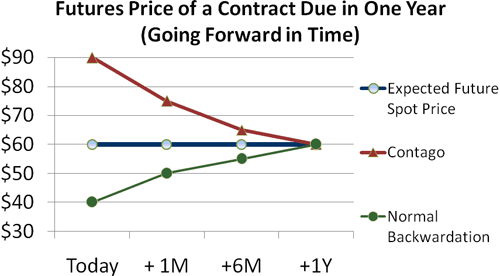
Contango is the financial phenomenon when future prices are higher than the expected future spot prices.


The image below explaining contango is via Investopedia


The announcement of the new ETF is via SeekingAlpha and Hard Asset Investor:

" ...
New ETFs Dodge Contango
Written by Hardassetsinvestor.com
July 24, 2007 12:44 PM EST
The vicious contango that has plagued investors in oil and energy futures finally appears to be going away, but product issuers are busy developing products that allay its impact … just in case it reappears.

A futures market is in contango when the price of a commodity for future delivery is more expensive than the spot price, i.e., when oil costs $70/barrel today but $75/barrel tomorrow. That harms futures investors relying on the traditional futures investing methodology, which holds the current month’s futures contract until it expires and then “rolls” that position into the net month’s contract. If next month’s contract is more expensive than this month’s contract, an investor effectively loses money on every trade.

The futures market periodically swings from contango to its opposite, backwardation, and there has recently been a long and vicious contango in the energy markets. Contango is to blame for the poor returns in futures-based commodities ETFs such as the United States Oil Fund (USO) or the iShares GSCI ETF (GSG): Despite the fact that oil prices are at or near record highs, investors in these funds have lost a significant amount of money over the past year, much to their chagrin.

Despite the fact that contango has been lessening of late, firms on both sides of the Atlantic have recently laid plans to launch new ETFs that aim to sidestep the contango issue.

First, as reported in ETF Watch, the developers of USO filed with the Securities and Exchange Commission (SEC) for the right to launch the United States 12 Month Oil Fund. Rather than simply investing in the near-month contract, this new fund will track the return of an equal-weighted position in the next 12 months of oil futures contracts. While not explicitly addressing the issue of contango, this strategy will reduce its impact on the fund, as that blended futures curve is traditionally less subject to contango than the near-term markets. ..."

Interesting situation with spot oil prices rising but future oil prices vectors are pointed downwards. As the speculative trading is in oil futures it is somewhat hard to profit from high oil prices with contango at hand.

Read More......

Some more info on the elusive Laffer Curve

Some research from Congressional Budget Office (dis)proving Laffer curve in 2001-2003 Bush tax cuts. WSJ's less technical version is below...

...The stimulative effect of Bush’s tax cuts has worn off and the supply-side benefits are "small,” the Congressional Budget Office says. At the request of House Budget Committee [chair] John Spratt (D., S.C.), the CBO analyzed the impact on the economy other than through the direct impact on tax revenues of the Economic Growth and Taxpayer Relief Act of 2001 (EGTRRA) and the Jobs and Growth Tax Relief Reconciliation Act of 2003 (JGTRRA).

In a letter to Spratt released Friday, CBO director Peter Orszag said, “The short-term effects of EGTRRA and JGTRRA in stimulating aggregate demand in the economy have largely dissipated by now, and the supply-side effects of those policies are uncertain but are probably small.”

Some of the tax cuts’ provisions “increased incentives for people to work and save (which can increase growth), but other provisions had no effect on incentives. In addition, the two tax laws increased the budget deficit, and doing so tends to reduce economic growth over the medium and long term. At this point in time (several years after enactment), once those various factors have been taken into account, the overall impact of the tax legislation on the economy is likely to be modest,” Orszag wrote.

Orszag concluded that the tax cuts’ indirect impact on economic growth, investment and saving and could affect this year’s budget deficit anywhere from an increase of $3 billion to a reduction of $14 billion, depending on the assumptions used. That is separate from the direct boost to the deficit through lost revenue and the added interest on borrowing to cover the gap of $211 billion.

It currently expects this year’s deficit to be between $150 billion and $200 billion, implying that without the tax cuts, the budget would probably be in surplus this year. ..."

One of the their findings is that the economy supposedly was on the left side of the laffer curve, thus a reduction in the tax rate reduced the government revenues. There is an interesting debate on Mark Thoma's blog.
The picture of the recent Laffer curve-related blunder from WSJ is below:


Read More......

Friday, July 20, 2007

On True Random Number Generators

As you already know mathematical procedures to produce high volumes of random numbers are intrinsically biased and prone to produce auto correlations at high volumes. As for example RAND function in Excel. Moreover, Monte Carlo for finance purposes often does require high density high volumes of random numbers.
Behold the return of the truly random number generators (Via Slashdot)based on physical phenomena rather than complex mathematical formulas! Even if the similar projects have been out for some time it's still interesting due to its allegedly fast (24 mbits) random number streams. Read on..


Listing of other random number genereators:

Atmospheric noise [random.org]
Lava lamps [lavarnd.org]
Radioactive decay [fourmilab.ch]
Entropy [hd.org]

An intro from QRBGS:

" ...
The work on QRBG Service has been motivated by scientific necessity (primarily of local scientific community) of running various simulations (in cluster/Grid environments), whose results are often greatly affected by quality (distribution, nondeterminism, entropy, etc.) of used random numbers. Since true random numbers are impossible to generate with a finite state machine (such as today's computers), scientists are forced to either use specialized expensive hardware number generators, or, more frequently, to content themselves with suboptimal solutions (like pseudo-random numbers generators).

The Service has begun as a result of an attempt to fulfill the scientists' needs for quality random numbers, but has now grown to a global (public) high-quality random numbers service.

Design requirements for our service were:
true randomness of data served (high per-bit-entropy of served data)
high speed of data generation and serving
high availability of the service (including easy and transparent access to random data,
great robustness of the service, and
high security for users that require it.

So far, all these features, except the last one, have been implemented.
And the solution developed tops other currently available random number acquisition methods (including existing Internet services) in at least one of the numbered categories.

To ensure high-quality of the supplied random numbers (true randomness) and high speed of serving, we have used fast non-deterministic, stand-alone hardware number generator relying on photonic emission in semiconductors. The used Quantum Random Bit Generator was previously developed at Rudjer Boskovic Institute, in Laboratory for Stochastic Signals and Process Research (for details, see below)... "

And it even has libs for Matlab and C++. So it's good for some testing or research. I would however go for insourced local random number generator to avoid internet chainlink at all for finance or crypto purposes.


Update:
Forgot to put some info on Monte Carlo in Excel for sales forecasts:


Read More......

Tuesday, July 10, 2007

Giffen Behaviour and Upward Sloping Demand

The elusive Giffen good finally pinned down in an academic paper by Robert T. Jensen, Nolan H. Miller, NBER WP 13243, July 2007 (via Economist's view). Does that mean that everybody that put an upward sloping demand curve can have it right? Read on...

An abstract:

"...
ABSTRACT
This paper provides the first rigorous, empirical evidence of the existence of Giffen behavior, i.e.,
a situation in which consumers respond to an increase in the price of a good by demanding more of
it. We begin by examining several theoretical approaches to the Giffen phenomenon and show that
in each case Giffen behavior is closely associated with poor consumers' need to maintain subsistence
consumption in the face of an increase in the price of a staple commodity. We then present evidence
on the existence of Giffen behavior among extremely poor households in two provinces of China.
In order to obtain an unbiased estimate of the key price elasticity, we conducted a field experiment
in which we randomly subsidized households' primary dietary staple (rice in Hunan province and wheat
flour in Gansu province). Using consumption data gathered before, during and after the intervention,
we find strong evidence of Giffen behavior with respect to rice in Hunan province. We also find evidence
for Giffen behavior in Gansu with respect to wheat; however, the evidence is less robust than for Hunan,
due to the (unanticipated) failure of at least two of the theoretical conditions that appear necessary
for Giffen behavior. Restricting the Gansu sample to households that meet these conditions provides
stronger evidence of Giffen behavior. ..."

And for a long discussed difference between Veblenian and Giffen goods:

"...
[1] We use the term “Giffen behavior” rather than “Giffen good” to emphasize that the Giffen property is one that holds for particular consumers in a particular situation and therefore depends on, among other things, prices and wealth. Thus, it is not the good that is Giffen, but the consumers’ behavior. The Giffen phenomenon should also not be confused with prestige or Veblen goods, where price signals quality and/or consumers desire the goods precisely because the price is high. Giffen behavior is a phenomenon that arises entirely within the neoclassical framework where consumers care about price only inasmuch as prices affect their budget sets, which rules out prestige goods.
... "

The definition of the Giffen behavior looks more robust, decoupling it from the intrinsic good characteristics and creating a more complete model with prices, wealth and a particular substitutes set.

Read More......

Friday, July 06, 2007

Swarm Intelligence

Swarm Theory - An emergent intelligence with sufficient critical network mass to create a meta intelligence surpassing that of the individual member of the swarm. It made to the mainstream media with the recent article in the National Geographic though the concept is quite known in population dynamics, sociology and modeling. Now for more debate...

First the mainstream datapoint.
National Geographic article
"...

How do we explain, then, the success of Earth's 12,000 or so known ant species? They must have learned something in 140 million years.

"Ants aren't smart," Gordon says. "Ant colonies are." A colony can solve problems unthinkable for individual ants, such as finding the shortest path to the best food source, allocating workers to different tasks, or defending a territory from neighbors. As individuals, ants might be tiny dummies, but as colonies they respond quickly and effectively to their environment. They do it with something called swarm intelligence.

Where this intelligence comes from raises a fundamental question in nature: How do the simple actions of individuals add up to the complex behavior of a group? How do hundreds of honeybees make a critical decision about their hive if many of them disagree? What enables a school of herring to coordinate its movements so precisely it can change direction in a flash, like a single, silvery organism? The collective abilities of such animals—none of which grasps the big picture, but each of which contributes to the group's success—seem miraculous even to the biologists who know them best. Yet during the past few decades, researchers have come up with intriguing insights. ..."

Then the Global Guerillas use of the concept when applied to guerilla networks (note the lack of the usual "terrorist" monicker):

"...
In essence, it provides readers with insight into how small autonomous entities (in our case guerrilla groups with a diverse set primary loyalties and thereby a similarly diverse set of motivations for why they fight), armed with simple rules of behavior (the rules of open source warfare), can coordinate (via stigmergic signaling) their actions to produce intelligent behavior at the aggregate level (an emergent intelligence sufficient to fight a war at the operational and strategic levels).

NOTE: Swarm theory also informs us on the potential effectiveness of unsupported organic terrorists in the West. Without an open source network in residence, the organic terrorist in the developed West is much more likely to fail than not (very much like a small group of bees/ants disconnected from the swarm -- lost and confused). However, improvements in virtual environments that provide new sources of connectivity are starting to unlock this potential -- although this type of development usually takes longer to develop than most people suspect. It may take a decade for the ratio to shift to where there are more successes than failures. ..."

Also on emergent intelligence from the same blog:

"...
What is emergent intelligence? It is a form of macrointelligence that arises from local interactions. It isn't merely the simple stigmergic interactions (Stigmergy is a term used in biology -- from the work of french biologist Pierre-Paul Grasse -- to describe environmental mechanisms for coordinating the work of independent actors) necessary for the coordination of the swarm activities of local autonomous agents. Rather, it is a form of group intelligence that learns, achieves goals, and engages in self-preservation. There are five simple requirements for emergent intelligence (a good starting point for those that want to dive deeper into this subject is Steven Johnson's book "Emergence"): ..."

And the last tidbit of info on Google:

" ...
So what does this have to do with Google? The bird flocking simulation is very similar to the way the strategic direction of a company progresses. The center (core competencies) drifts over time based on who is in the company, where it has been, and some random factors. Google isn't following the rules laid out by the simulation, and a result their strategic center isn't drifting, it's standing still. They don't realize where the center is, and that is why they will eventually have their vulnerabilities exposed.

Google is launching products in all kinds of directions, and the business press loves them for it and proclaims it the new model of innovation, but all they are really doing is moving in random offshoots around a stable center instead of using innovation from random ideas to dynamically shift that center. The flock isn't moving together. The flock is working on the core, then going off in meaningless directions. That is why Google can't take the top spot in anything else..."

I don't agree much with the applicability of the swarm theory to Google. Flock supposes no hierarchy while drifting of the core center may be executed through spinoffs and alliance (inherently hierarchical functions) without moving the whole swarm. Nonetheless, the whole idea is fascinating and is worthy of additional studies.

Read More......